This presentation is confidential. Enter the access password to continue.
Confidential — prepared for ANZ
Confidential — prepared for ANZ
Competitive economics. Stronger resilience. A future-ready platform.
Our proposal will improve ANZ's cost base by lowering both platform and SMS operating costs, with implementation included at no additional charge. It also strengthens resilience and long-term readiness through built-in multi-vendor failover, diversified message routing, and enterprise-grade support.
$96,000 AUD
Annual platform cost
Inclusive of API connectivity and single sign-on.
Pricing
$25,000 AUD
Signature Success
Optional add-on for a designated success lead and Salesforce's highest level of proactive support.
Pricing
1.8c AUD
Per SMS message
Superior conversion rate can be achieved by ANZ by converting to 1.2c USD.
Pricing
Reduce ↓
Cost per SMS
Reduced cost per SMS and improved commercial leverage at scale.
Commercial
Reduce ↓
Total cost of ownership
Lower total cost of ownership through platform consolidation.
Commercial
Reduce ↓
Inbound service demand
Reduced inbound service demand through self-service messaging flows.
Operational
Improve ↑
Delivery resilience
Improved delivery resilience through multi-network failover design.
Resilience
Improve ↑
Trust outcomes
Better trust outcomes through alpha tag protection and verified message history.
Trust
Improve ↑
Speed to new use cases
Faster rollout of new use cases because ANZ is building on platform, not bespoke carrier infrastructure.
Capability
SMS supplier of
Resilience · Trust · Future Capability
Not a carrier swap — a resilience and platform decision.
After the network outages of the last two years, banks like ANZ need messaging capabilities that aggregate beyond a single point of failure. This gives them continuity, control, and the capability to grow. Salesforce offers a more resilient enterprise messaging model, starting with API-triggered messaging on day one, while creating a path to broader communications, fraud controls, and two-way service over time. Creating the opportunity to reduce cost and simplify architecture by consolidating messaging platforms across business units and channels.
$0
Implementation cost
2
Major carrier outages in 18 months — Telstra 2026, Optus 2025
1
Enterprise platform for every message ANZ sends
1.2c
USD per SMS
SMS supplier of
The Resilience Case
Single carrier dependency is a risk even the telcos are hedging against.
ANZ's Telstra model solves for aggregation, but it still concentrates risk in a single network. Recent industry events have moved the bar for what "good enough" enterprise messaging looks like.
Two telco outages in 12 months
Two separate nationwide disruptions from two different telcos in the last year shed light on the risk of being dependent on any individual carrier for critical messaging. When the single carrier fails, ANZ's messaging fails with it.
Concentration risk at the worst moment
A carrier outage or routing issue exposes ANZ's messaging at the exact moment reliable customer communication matters most — OTPs, fraud alerts, payment confirmations. Resilience posture should not depend on a single carrier path.
The bar has moved
For a bank, resilience and trust are inseparable — and recent outages have redefined "good enough." Single-network dependency is now an operational and risk question, not a procurement decision.
Even the telcos recognise the value
These risks and opportunities are recognised even by the telcos. Two of whom now use Salesforce for SMS to their own customers.
Continuity by design. Trust built into the message.
Resilience
Multi-network failover
Continuity when a single carrier path is impaired
Routed across networks
An aggregator model supports failover across carriers — directly improving delivery resilience and continuity posture.
Critical sends keep moving
OTPs, fraud alerts and payment confirmations route around a failing network instead of stopping with it.
Designed for the events we've seen
The Telstra 2026 and Optus 2025 outages are exactly the failure mode a routed model is built to withstand.
Fraud & Trust
Alpha tag protection & verification
Reduce spoofing · give customers a trusted record
Alpha tag protection
Reduces spoofing risk — critical when customers judge message legitimacy in real time, often under stress during a fraud event.
Triggered 2FA & call follow-up
Messaging for two-factor authentication and suspicious-call follow-up — verification patterns beyond one-way alerts.
Verified message history
A trustworthy record of bank communications customers can check when something feels off — a defence against impersonation.
How the aggregator model protects the pipe
Validated senders route through Sinch to registry checks (OAV · NRS) and out across multiple carriers. Unauthorised platforms are blocked before they ever reach a network — and spoofed "ANZ" senders are stopped at the carrier edge.
The Salesforce Model
Why Salesforce — Four value pillars
Competitive SMS economics. With one messaging platform, enterprise-grade governance, and routing resilience through an aggregator model rather than dependence on a single carrier. Design for continuity, failover, and future growth.
The value pillars behind the proposal
PILLAR 01
Cost
Attractive — but not just one piece of the puzzle
Highly competitive versus the current Telstra arrangement at 1.2c USD per message. At ~168M SMS a year, even small unit-rate improvements translate into meaningful annual savings, plus a broader platform TCO benefit from consolidating messaging and reducing vendor fragmentation. Additionally, Salesforce will offer ANZ free implementation of this messaging capability.
$96,000 AUD
Annual platform cost — inclusive of API connectivity and single sign-on.
$25,000 AUD
Signature Success — optional add-on for a designated success lead and Salesforce's highest level of proactive support.
1.8c AUD
Per SMS message — superior conversion rate achievable by converting to 1.2c USD.
PILLAR 02
Operational uplift
Proven at scale · one async platform
Salesforce already supports high-volume messaging for major banks, telcos and large enterprises — so ANZ takes no platform risk to modernise. And messaging stops being a standalone utility: it joins one asynchronous platform that is secure, feature-rich, and aligned to enterprise customer engagement.
PILLAR 03
Resilience & fraud protection
Failover · alpha tag protection
A single-carrier model left ANZ exposed to events like the Telstra (July 2026) and Optus (September 2025) outages; a routed aggregator model supports failover across networks. Alpha tag protection reduces spoofing, and triggered 2FA and message verification give customers a more trustworthy record of bank communications.
PILLAR 04
Greater capability & path to growth
Two-way agentic · platform roadmap — click to expand
This does not stop at one-way SMS — any outbound notification can become a two-way, agentic conversation where the customer acts in the thread rather than calling the contact centre. Day one is API-triggered messaging; the platform opens a roadmap into service, fraud operations and self-service — a better ROI story than a narrow carrier replacement.
Where This Goes
Day one is SMS. The platform is a roadmap.
This does not stop at one-way SMS. Any outbound notification can become the start of a two-way, agentic conversation — a stronger ROI story than a narrow carrier replacement.
CAPABILITY 01
Any alert → agentic conversation
A one-way notification becomes a two-way thread where the customer takes action directly — rather than calling the contact centre or switching channels.
CAPABILITY 02
Fraud operations & verification
Triggered 2FA, suspicious-call follow-up and message verification move messaging from outbound alerting into an active fraud-management and trust capability.
CAPABILITY 03
Digital self-service at scale
The same platform opens a path into service and self-service journeys — new use cases rolled out on platform, not on bespoke carrier infrastructure.
CAPABILITY 04
Additional channels
Beyond network failover, deliver on cheaper or preferred channels like email or push — and extend to emerging channels such as RCS.
Phase 1 · Day one
Migrate & secure
API-triggered messaging on Salesforce
API-triggered messaging live
The immediate requirement solved — transactional sends on Salesforce with competitive economics.
Resilience & alpha tag protection
Routed failover and spoofing protection in place from the start.
Phase 2 · Over time
Extend & converse
Two-way, agentic, fraud-aware
Two-way agentic service
Replies resolve in-thread; verification and fraud workflows extend the channel.
Broader digital engagement
New journeys added on platform — without closing off the path chosen on day one.
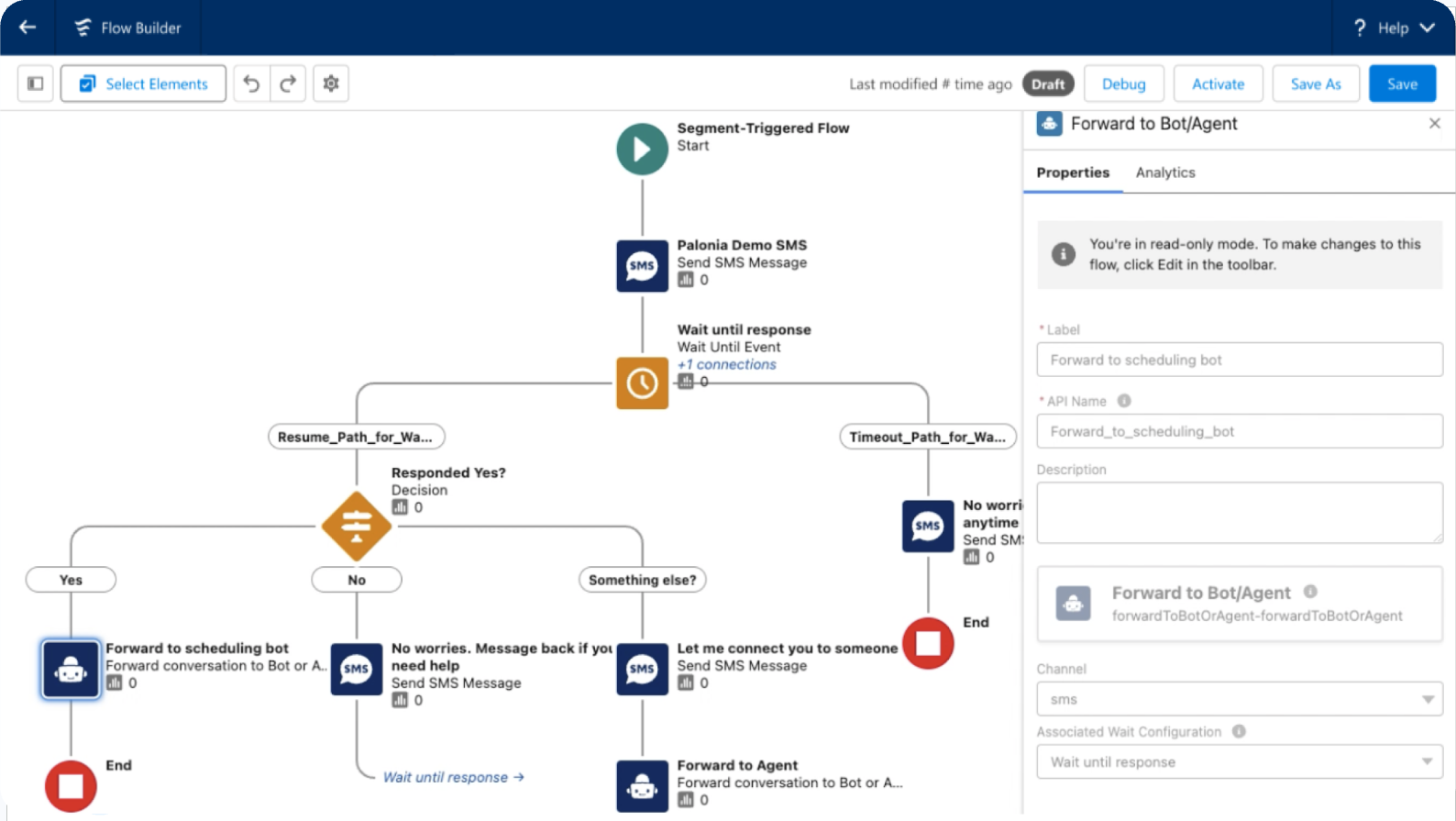
Flow Builder screenshot pending — drop the image at assets/screens/flow-builder.png and redeploy.
Appendix · Reference architecture
One gateway. Every business unit. Carrier-aware routing, built-in failover.
ANZ business units send SMS via one API. The gateway orchestrates delivery over carrier-specific "clean pipes", reroutes automatically if a carrier is impaired, and mirrors every message into the ANZ app so customers can verify it genuinely came from the bank.